
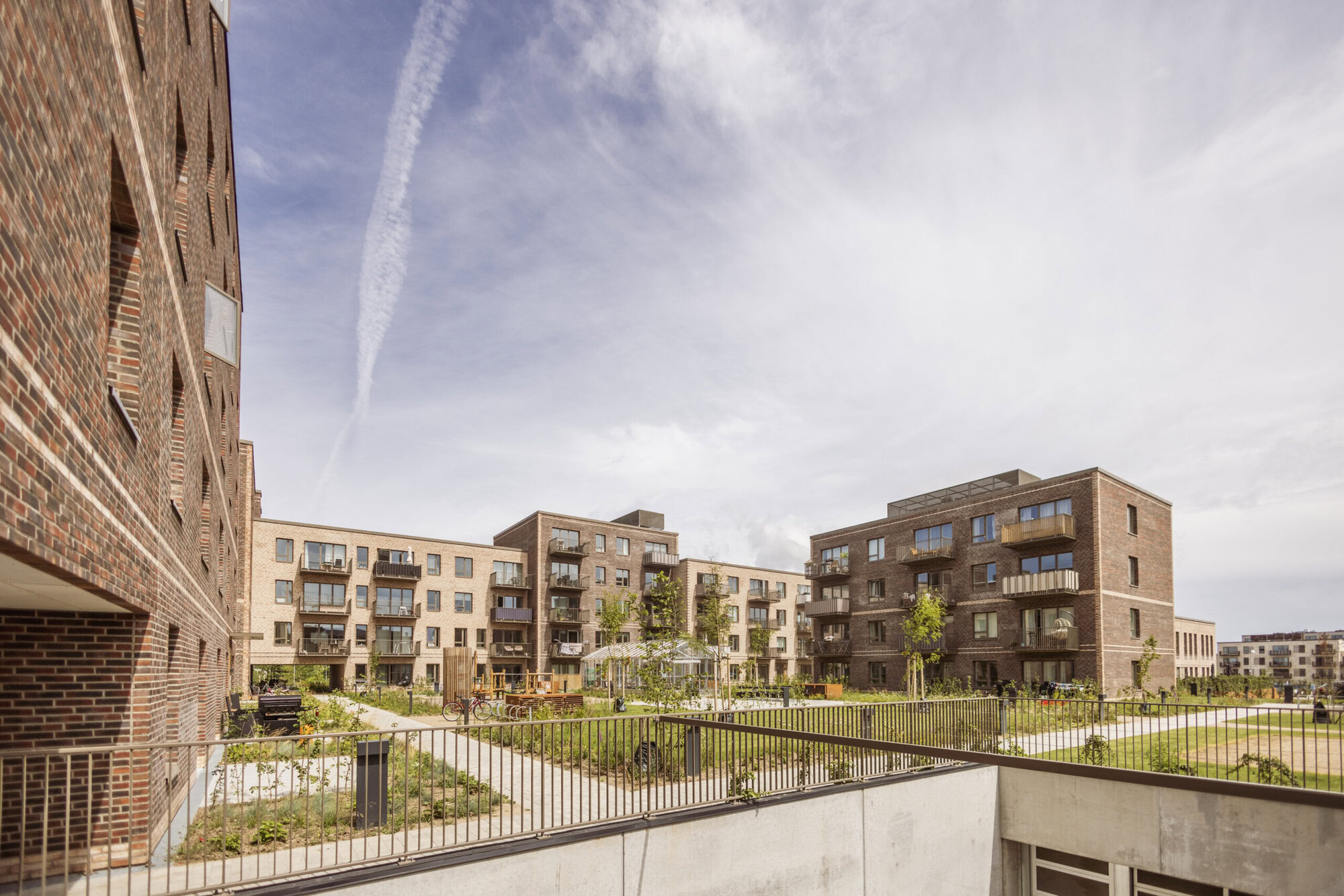
Elmen in Søkvarteret Nærheden (NH6)
FROM AMBITION TO RESULT
AT 5.8 KG CO₂E/M²/YEAR
CAN YOU ACHIEVE A LOW LCA — AND STILL BUILD WITH CONCRETE ELEMENTS?
The answer is yes. The new residential development Nærheden NH6, also known as Elmen, is now complete, the residents have moved in — and the result speaks for itself: 5.8 kg CO₂e/m²/year. The project is a benchmark for how concrete can continue to play a central role in construction in both 2027 and 2029.
HIGH AMBITIONS FROM THE START
When FB Gruppen and Ingcon launched the project, the goal was ambitious: to achieve a low carbon footprint of 6.55 kg CO₂e/m²/year — well below the BR18 limit value. The path to achieving this involved a meticulous review of structures and material choices. Nothing was taken for granted.
As director Anders Bidstrup from Ingcon put it:
— Previously, I could — said with all due humility — dimension a house like this in my head. But here we threw out the standard solutions and CO₂-optimised everything.
To achieve this goal, it was necessary to use a significantly greater proportion of lightweight concrete in the construction than would traditionally have been the case. This means that all facades and apartment dividing walls that are not balcony-bearing were made in lightweight concrete.
— We have done this before, explained Anders Bidstrup. But in connection with NH6, the exercise has been to see how low a cement content we can achieve in lightweight concrete, and how low a cement content we can achieve in the concrete that needs to be balcony-bearing.
As part of that process, CRH Concrete has therefore tested and trialled demoulding the concrete at various strengths, and has concluded that it is possible to use C20 concrete where C35 would previously have been chosen. In addition, both the concrete elements and the lightweight concrete elements are produced in low carbon concrete — which is now our standard.
FROM CLASSIC CONSTRUCTION TO CO₂-OPTIMISED STRUCTURE
The development comprises 123 apartments across five storeys with a basement, and nine terraced houses over two floors. The structure follows a classic layout with a heavy backing wall, insulation and brick facade — but behind the brickwork lies a series of crucial optimisations:
A significantly greater proportion of lightweight concrete elements than usual Reduced cement content in load-bearing structures Use of C20 concrete where C35 would previously have been chosen Production of all elements as low carbon concrete (formerly LCC), which is now standard
The Nærheden NH6 project achieved an LCA result of 6.0 kg CO₂e/m²/year — equivalent to 5.8 kg CO₂e/m²/year using the new emission factors from 1 July 2025.
ALL ELEMENTS UNDER SCRUTINY
It is not only the use of concrete that has been examined in detail. Every single element in the construction has been meticulously reviewed to identify CO₂ reductions.
— The entire building has gone through a process where we said that what we normally do, we throw out. The exercise has then been CO₂ optimisation, says Anders Bidstrup.
— We have done this in collaboration with CRH Concrete but also with all other parties. All materials have been selected on the basis that we wish to retain the traditional structure with a heavy backing wall, insulation and a brick facing wall. So we have made some CO₂-optimised choices whilst also optimising the process. We know which parameters we can adjust. And since we have worked together with FB Gruppen, AFRY, Sweco, CRH Concrete and several of the suppliers and subcontractors for many years, it has been easier for us to fine-tune the process.
Anders Bidstrup continues: — In collaboration with the engineers from AFRY, we have tried to redistribute the forces throughout the building and investigate whether the construction can still withstand what it needs to. Previously, we had walls so strong at 18 cm and C35 that we could take a small facade section, calculate the transverse and longitudinal stability on that, and we were done.
He elaborates: — Now we reduced the structures to 15 cm and added considerably more lightweight concrete. The entire exercise was about limiting the amount of concrete. In collaboration with the architects, FB Gruppen and Ingcon have also tried to position the windows more appropriately so that they do not affect the stability of the building. Some of the windows have been raised 50–80 cm above floor level, and there is a bottom plate and a top plate in the concrete, which means that the concrete element achieves greater strength. With regard to the balconies, heavier brackets are used so that the balconies meet the required standards, even though the concrete is less strong.
EARLY INVOLVEMENT CHANGES THE PROCESS
The changed approach to the project has meant a longer process and a different rhythm in the planning phase. Ingcon A/S and FB Gruppen have had more meetings — and earlier ones — with the key partners than is normally the case. Consultants were brought in at an early stage, and the dialogue with CRH Concrete, for example, has been more intensive than in previous projects.
According to Anders Bidstrup, this has also changed the distribution of resources. A larger proportion of the budget has shifted to the consultancy side, and although the use of lightweight concrete elements has reduced the element cost, the project has overall become more expensive as a result of the more stringent climate targets.
Despite the changed process, no new or untested materials have been used — the construction has been carried out using familiar solutions.
— It is a solid residential building that we are constructing. We are also accountable for a five-year review afterwards, and we like the fact that during the construction process we have control over water, odour and mould, explained Anders Bidstrup. — With the climate we have in Denmark, where it rains for a large part of the year, it is important to use materials that can withstand water during the construction period, and once the building is weathertight, the moisture-sensitive materials can be introduced.
DGNB CERTIFICATION WITH CONCRETE ELEMENTS
Nærheden NH6 demonstrates that concrete is not an obstacle to DGNB — quite the contrary. With precise data from product EPDs and well-documented solutions, concrete can form part of DGNB-certified construction projects. The development has been pre-certified to DGNB Platinum (manual 2023) and meets the climate requirements expected in the building regulations for both 2027 and 2029.
DGNB is not only about one parameter — it is about the balance between environmental, economic and sociocultural quality. Here, concrete stands strong.
Nærheden NH6 also demonstrates the importance of using the right data. With product EPDs and precise documentation, the CO₂ level for concrete elements is made clear. This changes the picture when comparing with other materials and supports a genuine and accurate basis for decision-making.
The development is a good example of how early dialogue and close collaboration between client, contractor, consultant and supplier can lead to tangible results. By challenging standard solutions and choosing optimised concrete elements, it has been possible to push the carbon footprint of the construction significantly downwards — whilst at the same time ensuring a long-lasting structure.
A REFERENCE PROJECT FOR THE FUTURE
Behind the attractive brickwork at Elmen in Nærheden lie the optimised solutions that together produced the impressive result of 5.8 kg CO₂e/m²/year. The development has been pre-certified with DGNB Platinum, manual 2023 (Nærheden 6 | Danish Green Building Council).
The project is a reference development that demonstrates how, using familiar materials and documented methods, it is possible to achieve results in relation to the expected climate requirements in the Building Regulations for both 2027 and 2029. It sends a clear signal: the DGNB-certified construction of the future can indeed be built with concrete. It is about using the material wisely, documenting performance and drawing on the experience that the construction industry has already built up.
_____________________________________________________
Client: FB Gruppen
Managing Contractor: Ingcon
Structural engineers: AFRY
Project facts:
132 rental homes in total 9 terraced houses over two floors and 123 apartments up to 5 storeys
Construction period: 2023 – 2025
DGNB Platinum (manual 2023) — pre-certified
_____________________________________________________