
THE CONSTRUCTION INDUSTRY’S RESOURCE BANK
REUSE OF HOLLOW CORE SLABS
The reuse of concrete can help to achieve a significant reduction in the construction industry’s CO₂ footprint, and a great deal of concrete is already being crushed and reused as a base layer in roads. But what are the possibilities for reusing concrete elements such as hollow core slabs directly in new construction? CRH Concrete has tested this in a trial carried out in collaboration with, amongst others, the Danish Technological Institute and Roskilde Municipality.
PROMISING TEST RESULTS
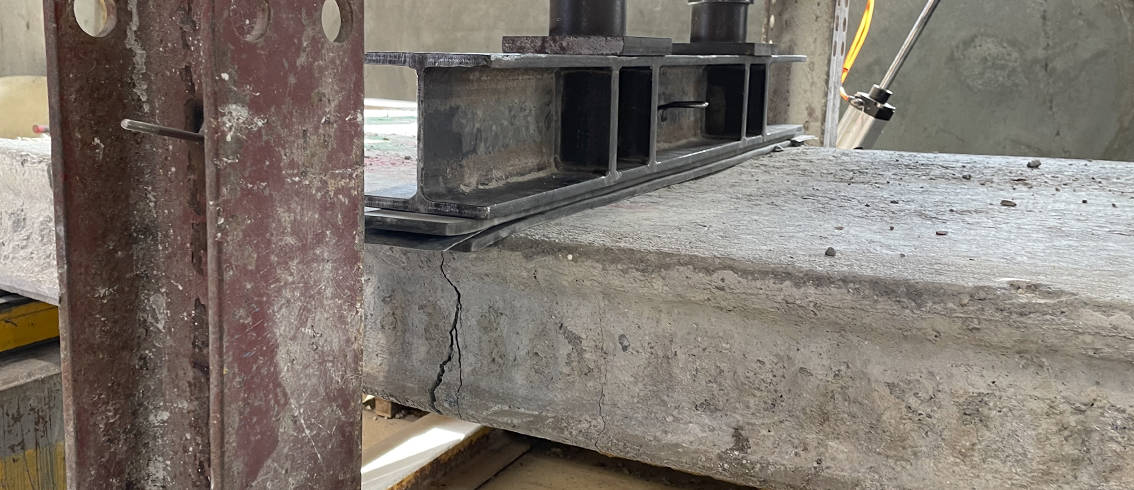
The hollow core slabs were cut free from an existing building that was due to be demolished. They were then tested to determine whether the slabs could be reused in their complete form. The tests were carried out on CRH Concrete’s test rig in Viby Sjælland, which is normally used for spot checks of CRH Concrete’s own production.
— We have run some shear tests in the same way as we do with our standard production. This has given us some values indicating the strength of the hollow core slabs. One of the slabs was very comparable to our PE slab and met the strength requirements of the test, says Lars Reimer, Technical Director at CRH Concrete.
— The other slab was a little more difficult to compare, because it had a cross-section that we do not know entirely, and it was 195 mm in height, whereas ours are 180 mm or 220 mm. This means that we cannot compare the slabs directly in terms of strength. But it appears to meet the requirements, says Lars Reimer.
CHALLENGES IN REUSE
Although the test indicates that it is possible to reuse hollow core slabs, there are several issues associated with doing so. One of the challenges is ensuring that reused hollow core slabs do not have damage that differs from that found on the tested slabs. In addition, it requires a more extensive logistics setup, and it may also be necessary to reinstate some of the slabs if they have too many holes in them.
— It is difficult, because there is a great deal of planning involved in the task. Should one create a stock of hollow core slabs from old buildings and register and store them at a central warehouse? It might then be possible to find hollow core slabs with a strand pattern that matches the design and cut them to length. But it may be that they need to be reinstated because there are too many holes, or new holes need to be made. Or do you discard those that have too many holes? There is therefore a significant logistics exercise involved in coordinating this, says Lars Reimer.
FILM OF SHEAR TEST: Watch the shear test that was carried out on our test rig at the hollow core slab factory in Viby Sjælland.
In addition to the logistical challenges associated with the direct reuse of hollow core slabs, it will also be necessary to clarify where responsibility for the elements lies.
— One thing is to test a few individual elements, but who is responsible for the elements that have not been tested when they are reused in a construction project? Perhaps labelling or some form of material passport could be an option? There are therefore many things that will need to be addressed, explains Lars Reimer.
SIGNIFICANT POTENTIAL
Despite the challenges, Lars Reimer sees significant potential in the reuse of hollow core slabs.
— Overall, the result is encouraging. Reusing an element in almost its full size represents by far the best form of reuse that we can practise. And that is actually the main point here — that we can now reuse an element in almost its complete form. So we are on our way, and at CRH Concrete we would very much like to be part of the further development, concludes Lars Reimer.


_____________________________________________________
MORE INFORMATION

PRODUCT AND PROJECT EPD
Download our product and project EPDs here:
Download EPDs

ELEMENTET #19-2023
Download the latest edition of ELEMENTET.
Download ELEMENTET

CO₂ LIMIT VALUE OF 6.55
Read how it was made possible at Søkvarteret, Nærheden. Read the article here
Read the article here
CC3-CLASSIFIED IN LIGHTWEIGHT CONCRETE
Widespread use of lightweight concrete despite CC3 classification
Read the article here